You leave for work. Your cat settles in for an 8-hour stretch of… what, exactly? Staring at the wall? Sleeping in the same spot until you return? If your cat isn’t mentally and physically stimulated while you’re away, boredom sets in — and bored cats develop behavior problems. The good news: with the right setup and routines, your indoor cat can stay entertained, engaged, and happy even when you’re not home.
This guide covers practical strategies to keep your cat stimulated during work hours, from interactive toys and feeding puzzles to environmental enrichment and routines that set your cat up for success.
Why Enrichment Matters When You’re Away
Cats are intelligent, curious animals with natural instincts to hunt, explore, climb, and patrol territory. Indoor cats don’t have access to the sensory-rich environment outdoor cats experience, so they rely on us to provide stimulation. When that stimulation is missing — especially during long stretches alone — cats get bored.
Signs your cat is bored or under-stimulated:
- Over-grooming or hair loss
- Destructive scratching of furniture
- Aggression toward you or other pets when you return home
- Excessive meowing or attention-seeking
- Overeating (if free-fed)
- Sleeping all day and being hyperactive at night
For a deeper look at boredom signs, see our article on signs your indoor cat is bored (if available). The solution is proactive enrichment — giving your cat things to do, see, and interact with while you’re gone.
Morning Routine: Set Your Cat Up for Success
What you do before leaving for work significantly impacts how your cat spends the day.
Play Before You Go
Spend 10–15 minutes engaging your cat in active play with a wand toy or laser pointer. Mimic prey movement — quick darting, pauses, hiding behind furniture. Let your cat “catch” the prey a few times (if using a laser pointer, always end by letting them catch a physical toy). This burns off energy and satisfies hunting instincts.
After play, offer a small meal. The natural cycle is hunt → eat → groom → sleep. A play-then-feed routine before you leave encourages your cat to settle into a nap rather than prowling for stimulation the moment you’re gone.
Puzzle Feeder Breakfast
Instead of serving breakfast in a regular bowl, use a puzzle feeder. This makes your cat work for their food, engaging their problem-solving skills and extending mealtime from 30 seconds to 10–15 minutes.
Types of puzzle feeders:
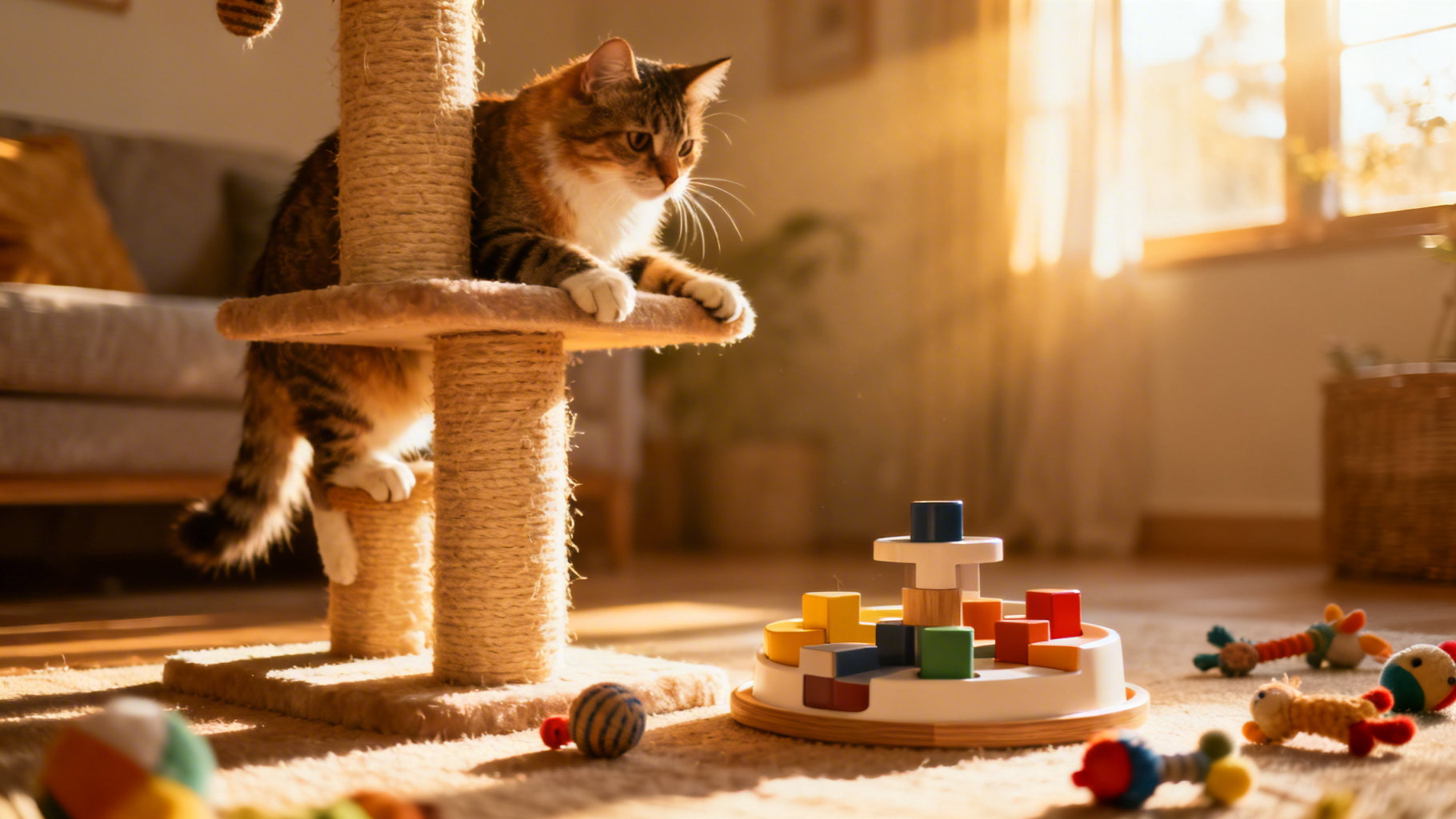
- Stationary puzzles: Food hidden in compartments or under sliding panels. Your cat has to paw, nudge, or manipulate pieces to access kibble. Good for cats who like to think.
- Rolling treat balls: Kibble dispensed as your cat bats the ball around the room. Combines mental and physical activity.
- Snuffle mats: Food hidden in fabric folds. Your cat “forages” by sniffing and pawing. Mimics hunting through grass.
For recommendations and reviews, see our guide to the best puzzle feeders for cats (if available).
Interactive Toys That Work While You’re Away
Not all toys are created equal when it comes to solo play. Your cat needs toys that stay interesting without human involvement.
Battery-Operated or Motion-Activated Toys
These toys move unpredictably, triggering your cat’s prey drive even when you’re not there to operate them.
Examples:
- Automatic laser toys: Projects moving laser patterns on walls and floors. Set them on a timer so they activate mid-morning or mid-afternoon.
- Interactive robotic mice or birds: Move erratically when activated. Some have motion sensors and turn on when your cat approaches.
- Track toys with balls: A ball trapped in a circular track your cat can bat around. Simple, but many cats find them endlessly entertaining.
Caution with lasers: Never leave a laser pointer running continuously without supervision. Use timers to limit sessions to 10–15 minutes. Always end laser play by letting your cat “catch” a physical toy or treat — this provides closure to the hunt and prevents frustration.
Toys That Encourage Solo Play
- Spring toys: Cheap, lightweight coils that cats bat around. Highly entertaining for many cats.
- Catnip or silvervine toys: Stuff a few around the house. Rotate them weekly so they stay interesting.
- Crinkle balls or foil balls: Lightweight, easy to bat, and make satisfying sounds.
- Tunnel systems: Collapsible fabric tunnels your cat can run through, hide in, and ambush from. Add a crinkle ball inside for extra fun.
Rotate Toys Weekly
Cats get bored of the same toys. Keep a rotation: put half the toys away for a week, swap them out for the other half the following week. This keeps toys feeling “new.”
Window Entertainment: The Best Free Enrichment
A window with a view is one of the most valuable enrichment tools you can offer an indoor cat. Watching birds, squirrels, people, and moving cars provides hours of mental stimulation.
Set Up a Window Perch
Place a sturdy cat perch, hammock, or shelf in front of a window with a good view. Make sure the perch is stable and large enough for your cat to stretch out comfortably. Bonus points if the window gets morning sun — cats love basking.
Attract Birds and Wildlife
If you have outdoor space (a yard, balcony, or patio), set up a bird feeder or bird bath within view of the window. Your cat gets to watch “Cat TV” all day. Even in urban settings, placing a window feeder with suction cups directly on the glass can attract birds.
Leave Blinds or Curtains Open
Obvious, but easy to forget. If your cat’s favorite window is blocked while you’re at work, they’re missing out on major enrichment.
Catio or Enclosed Outdoor Access
If you have the budget and space, a catio (enclosed outdoor patio for cats) provides safe outdoor access. Your cat can experience fresh air, sights, sounds, and smells without the risks of free roaming. Even a small window box catio can make a huge difference.
For more on creating vertical and window-based enrichment, see our guide to cat furniture and vertical space (if available).
Feeding Strategies to Extend Engagement
Food is a powerful motivator. Use it strategically to keep your cat occupied.
Hide Food Around the House
Instead of serving all meals in one bowl, scatter kibble in small portions around the house — on cat trees, window perches, in puzzle toys. Your cat has to “hunt” for their food, which is mentally stimulating and more satisfying than eating from a bowl.
Timed Automatic Feeders
Set an automatic feeder to dispense a small meal or snack mid-day. This breaks up the monotony of the day and gives your cat something to look forward to. Some feeders can even be controlled via smartphone, so you can surprise your cat with a treat while you’re at lunch.
For recommendations, see our guide to the best automatic feeders (if available).
Freeze Wet Food or Treats in a Puzzle Toy
If your cat will be home for a long stretch, freeze a small amount of wet food or treats inside a Kong-style toy. Your cat has to work to extract the food as it thaws, providing 20–30 minutes of focused activity.
Environmental Enrichment: Make Your Home Interesting
Your home is your cat’s entire world. Small changes can make it much more engaging.
Vertical Space
Cats are climbers. Vertical territory — cat trees, wall shelves, bookcases — allows your cat to patrol from different heights, which is instinctively satisfying. Cats also feel safer when they can observe from above.
Install a few cat shelves or a tall cat tree near windows or in rooms your cat frequents. Make sure they’re stable — a wobbly perch will be ignored.
Scratching Posts and Pads
Scratching is a natural behavior. Provide multiple scratching surfaces in different textures (sisal, cardboard, carpet) and orientations (vertical posts, horizontal pads, angled). Place them in high-traffic areas and near where your cat sleeps.
Hiding Spots and Safe Spaces
Cats need places to retreat and feel secure. Cardboard boxes, cat caves, tunnels, and even paper bags (with handles removed) give your cat options for hiding and resting. Rotate these periodically to keep the environment feeling fresh.
Safe Plants
Cat-safe plants like cat grass, catnip, or spider plants (in moderation) add sensory interest. Many cats enjoy nibbling on grass or batting at dangling leaves. Just make sure any plants you bring home are non-toxic to cats — many common houseplants (lilies, pothos, philodendron) are poisonous.
Background Noise
Some cats are comforted by background sound. Leave a radio or TV on at low volume, or use a white noise machine. There are even YouTube channels and apps designed specifically for cats, featuring birds, fish, and squirrels.
Social Enrichment: Consider a Second Cat
If your cat is social and enjoys the company of other cats, a feline companion can provide entertainment and comfort while you’re away. Two cats often play together, groom each other, and keep each other company.
Important caveats:
- Not all cats want a companion. Some cats are happier as solo pets.
- Introductions must be done slowly and carefully to avoid stress and aggression. See our step-by-step guide to introducing a kitten to an adult cat for the process.
- Two cats mean more work: more litter boxes, more feeding logistics, more vet bills. Make sure you’re prepared for that.
If your cat is already showing signs of boredom and enjoys playing with other cats (at the vet, in foster situations, or previously in multi-cat homes), a second cat is worth considering.
After-Work Routine: Reconnect and Recharge
What you do when you get home matters just as much as what you do before you leave.
Dedicated Play Session
Spend 15–20 minutes engaging your cat in active play as soon as you’re settled. This is quality bonding time and helps burn off any pent-up energy from the day. Use a wand toy, laser pointer, or whatever your cat loves most.
Feeding Time
If your cat eats dinner, serve it after your evening play session. The hunt-eat-groom-sleep cycle kicks in, and your cat is more likely to settle for the evening rather than zooming around at midnight.
One-on-One Attention
Spend quiet time with your cat — petting, grooming, or just sitting together. Physical affection and social interaction are important for your cat’s emotional health.
What About Overnight and Weekends?
Your cat’s enrichment needs don’t stop when you’re home.
- Keep routines consistent: Feed and play at roughly the same times every day, even on weekends.
- Weekend adventures: If your cat is harness-trained, take them for a supervised walk or let them explore a safe outdoor space like a catio or enclosed yard.
- Rotate enrichment: Swap out toys, rearrange furniture slightly, introduce new hiding spots or perches. Small changes keep the environment interesting.
For a complete guide to keeping your indoor cat mentally and physically stimulated, see our Indoor Cat Enrichment Guide.
Final Thoughts
Your cat doesn’t need constant entertainment — they’ll nap for a good chunk of the day no matter what. But providing enrichment while you’re at work ensures that the hours they are awake and alert are satisfying, not frustrating. A morning play session, puzzle feeders, window access, solo-play toys, and a stimulating environment go a long way toward keeping your cat happy and well-adjusted.
The effort you put into enrichment will pay off in a calmer, healthier, more content cat — and fewer 3 AM zoomies.