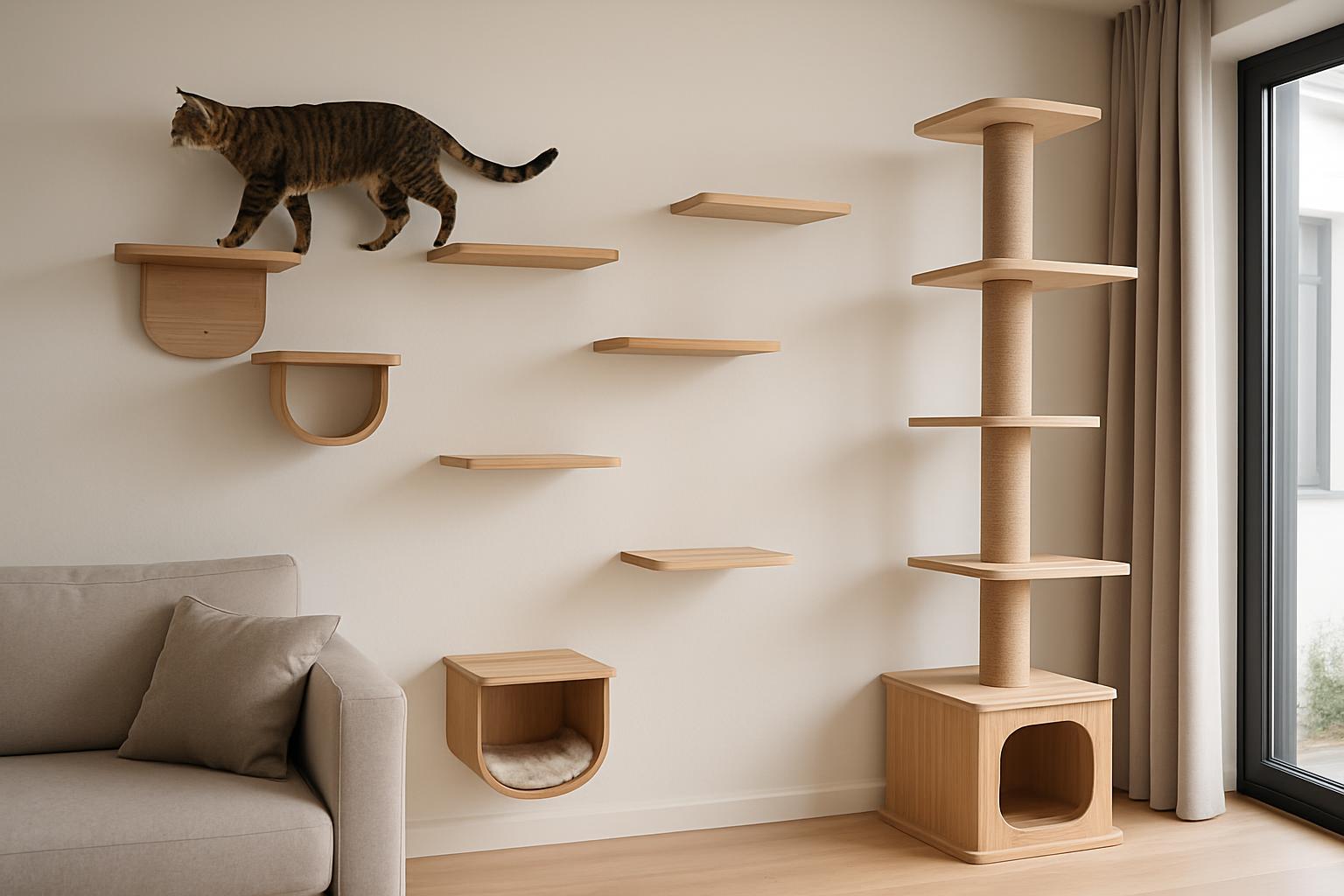
Vertical space is one of the most powerful tools you have for making an indoor cat’s life richer, healthier, and less stressful. Cats are natural climbers — in the wild, they use height for safety, hunting, and territorial advantage. Indoors, vertical territory gives them exercise, reduces conflict in multi-cat homes, and satisfies deep instincts that horizontal space alone can’t address. This guide covers every way to maximize your cat’s vertical world.
Why Vertical Space Matters for Indoor Cats
Cats think in three dimensions. A 500-square-foot apartment with good vertical territory can feel larger to a cat than a 1,000-square-foot home without it. Here’s why height matters so much:
- Security: Cats feel safe up high. Elevated spots give them a vantage point to survey their territory — reducing anxiety and stress.
- Exercise: Climbing, jumping, and balancing engages muscles that walking on flat ground doesn’t. Vertical movement is excellent cardiovascular exercise.
- Territory: In multi-cat homes, vertical space effectively multiplies available territory. A cat on a shelf and a cat on the floor can coexist peacefully because they’re in “different” spaces.
- Enrichment: Navigating vertical routes provides mental stimulation and satisfies problem-solving instincts.
- Conflict reduction: When cats can establish vertical hierarchies (higher cat = more confident cat), there’s less need for ground-level confrontations.
If your indoor cat seems bored, anxious, or is fighting with other cats, inadequate vertical space is often a contributing factor. For more on enrichment, see our Indoor Cat Enrichment Guide.
Cat Trees: The Foundation of Vertical Territory
A good cat tree is the single most impactful piece of cat furniture you can buy. It combines height, scratching surfaces, resting platforms, and sometimes enclosed hideaways into one piece.
What to Look For in a Cat Tree
- Height: Taller is generally better — 5-6 feet is ideal for most homes. Cats want to be at or above human head height.
- Stability: The tree must not wobble or tip when jumped on. Heavy bases and wall-anchor options are important, especially for large cats. A wobbly tree is a tree your cat won’t use.
- Platform size: Each platform should be large enough for your cat to stretch out fully. Many cheap cat trees have platforms that are too small for adult cats.
- Scratching material: Sisal rope wrapping is the gold standard — durable and cats love the texture. Carpet-covered posts wear out faster and some cats won’t scratch carpet.
- Footprint: For apartments, look for “tall and slim” designs that maximize height while minimizing floor space.
Our Top Cat Tree Picks
For apartment dwellers, the Feandrea Cat Tree offers excellent height (56″) on a compact base with sisal-wrapped posts and multiple platforms. For larger spaces, the Go Pet Club 72″ tree gives cats a real climbing workout. Budget buyers should look at the Amazon Basics Cat Activity Tree.
Read our full guide: Best Cat Trees for Apartments
Placement Tips
Put your cat tree near a window if possible — the combination of height and an outside view is irresistible to most cats. Avoid tucking it in a corner where your cat can’t see the room. In multi-cat homes, having trees in different rooms prevents territorial monopolies.
Wall-Mounted Shelves and Climbing Systems
Wall shelves are the most space-efficient way to add vertical territory. They use zero floor space while creating elevated highways, resting spots, and climbing routes along your walls.
Pre-Made Cat Shelf Systems
Companies like CatastrophiCreations and FUKUMARU make purpose-built cat shelves with non-slip surfaces, rounded edges, and tested weight ratings. These range from simple individual shelves ($20-40 each) to complete wall-mounted playgrounds with bridges, hammocks, and sisal steps ($100-300+).
DIY Cat Shelves
Sturdy floating shelves from IKEA (like the LACK shelf) can be converted into cat shelves by adding non-slip shelf liner or carpet remnants. Space shelves 12-18 inches apart vertically so cats can comfortably hop between them. Always use appropriate wall anchors — cats jump with force, so shelves must hold 2-3x your cat’s weight.
Apartment-Friendly Options
If you can’t drill into walls, consider tension-mounted floor-to-ceiling cat poles, door-frame mounted perches, or freestanding climbing frames. Some cat shelf systems use adhesive mounts, though these are less reliable for heavier cats. For more rental-friendly ideas, see our Apartment Cat Setup Guide.
For detailed product reviews, read our best wall shelves and window perches guide.
Window Perches
Window perches give cats a warm, sunny observation post — “cat TV” with real birds, squirrels, and neighborhood activity. They’re one of the simplest ways to enrich an indoor cat’s life.
Types of Window Perches
- Suction cup mounted: The K&H EZ Mount and Oster Sunny Seat attach directly to windows with industrial suction cups. Easy to install and remove, no tools required. Check weight ratings carefully — most support 25-50 lbs.
- Shelf-style perches: Attach to the wall below the window and extend outward. More secure than suction mounts and support more weight. The SWEETGO cat window perch is a good example.
- Window sill extenders: Widen an existing narrow sill into a usable perch. Simple and unobtrusive.
Enhancing the View
Make window perches even more appealing by hanging a bird feeder outside the window. The combination of a comfortable perch and live bird-watching is endlessly entertaining for cats. Just make sure window screens are secure — excited cats can push through weak screens.
Catios and Enclosed Outdoor Spaces
A catio (cat patio) is an enclosed outdoor space that lets your indoor cat experience fresh air, sunshine, and outdoor sounds safely. Options range from window-box style enclosures to full balcony or porch conversions.
- Window catios: Small enclosures that attach to a window opening. Affordable ($100-300) and apartment-friendly.
- Balcony enclosures: Cat-proof netting or screening converts a balcony into a catio. Check with your landlord or HOA first.
- Freestanding outdoor enclosures: For homeowners, standalone catio structures can be simple (DIY with wire mesh and wood) or elaborate (custom-built with multiple levels and tunnels).
Any catio should have shade, shelter from rain, and a way for the cat to return indoors freely.
Creating Vertical Routes and Highways
Individual pieces of cat furniture become truly powerful when connected into routes. The goal is to create a “cat highway” — a continuous elevated path through the room or even through multiple rooms.
Designing a Cat Highway
- Start with a “launch point” — a cat tree or low shelf that’s easy to jump onto from the floor
- Create a route — shelves, bridges, or the tops of tall furniture leading along the wall
- Include rest stops — wider platforms or hammocks where cats can lounge mid-route
- Add a destination — a premium spot like a window perch, high shelf with a bed, or cat tree at the far end
- Provide exit points — cats need multiple ways down, not just one
In multi-cat homes, highways should be wide enough that cats can pass each other without confrontation, or provide bypass routes. For more about creating vertical territory in tight spaces, read how to create vertical territory in a small apartment.
Materials and Safety Considerations
- Weight testing: All elevated furniture should support at least 2-3x your heaviest cat’s weight, accounting for the impact of jumping
- Non-slip surfaces: Add carpet, sisal, or shelf liner to any smooth surface cats will walk or land on
- Secure mounting: Use appropriate wall anchors for your wall type (drywall vs. concrete vs. brick). When in doubt, use toggle bolts
- No toxic finishes: Cats may lick surfaces. Avoid shelves with chemical finishes or treated wood. Unfinished or water-based polyurethane finishes are safest
- Rounded edges: Sand or cover any sharp edges or corners on DIY installations
Vertical Space for Multi-Cat Homes
In multi-cat households, vertical space isn’t just enrichment — it’s conflict resolution. Cats establish hierarchies partly through vertical positioning. The more confident cat takes the highest spot; less confident cats find middle-height spots. Without enough elevated positions, cats compete more aggressively for limited high ground.
Aim for at least one elevated resting spot per cat, plus extras. Spread them throughout the home rather than clustering in one room. This gives every cat access to height regardless of social dynamics. For more multi-cat strategies, see our Multi-Cat Home Setup Guide.
Getting a Reluctant Cat to Use Vertical Space
Some cats — especially those who’ve never had vertical options — may need encouragement:
- Place treats or catnip on new shelves and platforms
- Use a wand toy to lure them up cat trees
- Start with low heights and gradually add higher options
- Make sure the structure is stable — one wobbly experience and many cats won’t return
- Place familiar bedding on elevated spots so they smell like “home”
- Be patient — some cats take weeks to explore new vertical territory
🐱 Free Indoor Cat Enrichment Checklist
Get our printable daily enrichment checklist — designed for busy cat owners who want to keep their indoor cats happy and healthy.
Coming soon — check back for the download link!