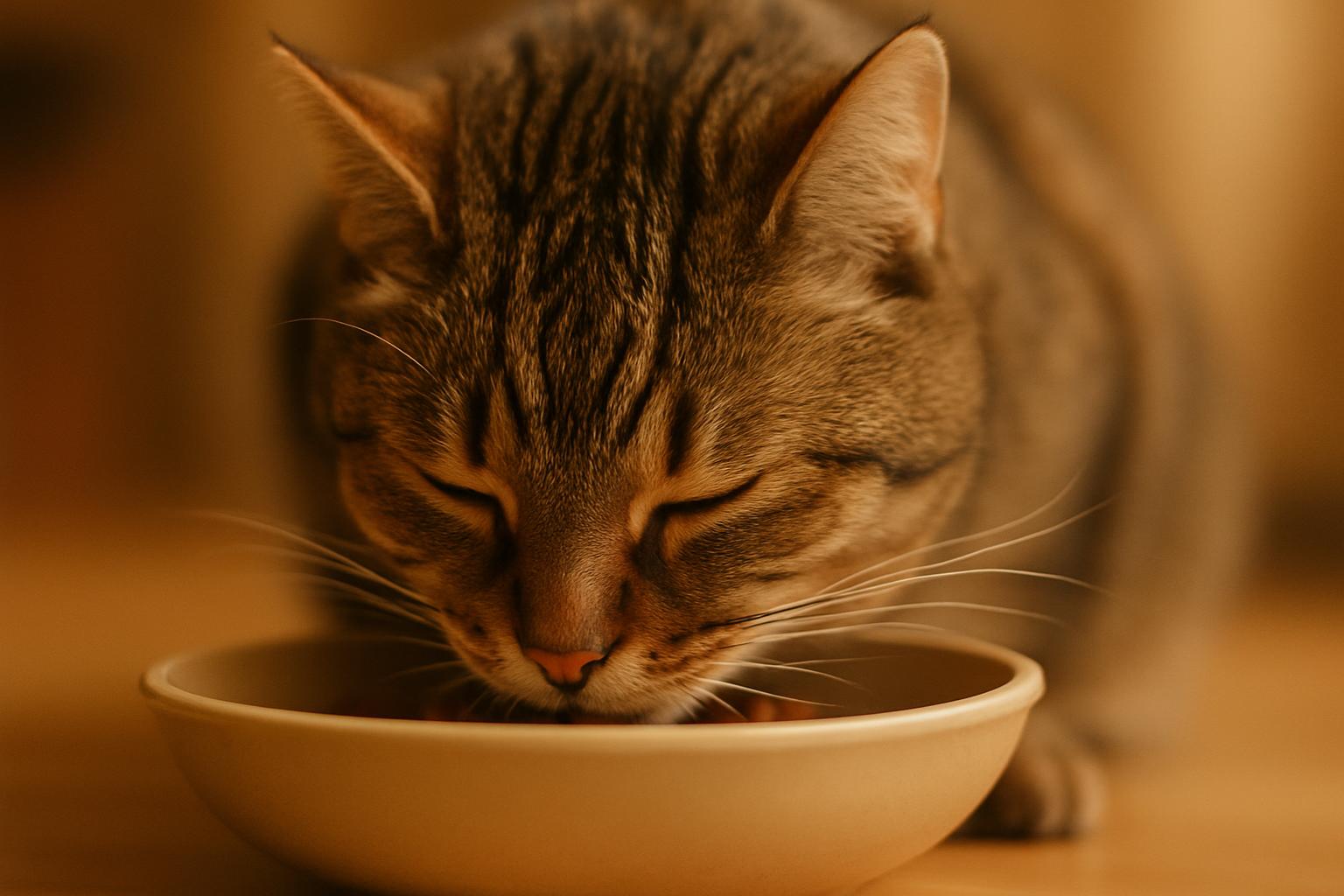
If your cat walks up to their food bowl, takes a few bites, then steps back and shakes their head — or refuses to eat altogether despite being hungry — whisker fatigue might be the culprit. It’s a real phenomenon that affects many cats, and the fix is often as simple as swapping out their dish.
What Is Whisker Fatigue?
Whisker fatigue (also called whisker stress) occurs when a cat’s whiskers are repeatedly overstimulated by contact with the sides of a narrow or deep food or water bowl. Cats’ whiskers — called vibrissae — are extraordinarily sensitive sensory organs. Each whisker is embedded deeply in the skin and connected to a rich network of nerves and sensory receptors called proprioceptors.
Unlike the hairs on your arm, whiskers don’t just feel touch — they detect fine changes in air currents and pressure, helping cats navigate tight spaces, judge distances, and read their environment. They’re essentially a sixth sense.
When a bowl forces whiskers to bend or press against the sides on every bite, those sensors get flooded with signals. Over time, this repeated stimulation can become uncomfortable, stressful, or even painful — much like touching an already-tender bruise repeatedly throughout the day.
The Science Behind It
While the term “whisker fatigue” isn’t a formal veterinary diagnosis, the underlying mechanism is well-understood: tactile overstimulation of the mystacial whisker pads. Each whisker has its own follicle with blood sinuses and a rich nerve supply — some researchers estimate cats have up to 24 movable whisker follicles per cheek, each individually innervated.
The proprioceptors at the base of each whisker send constant positional feedback to the cat’s brain. In the wild, whiskers work intermittently — brushing against grass, tunnels, or prey. In a deep food bowl, they receive continuous compressive stimulation on every single bite. The brain’s sensory cortex, built for occasional high-priority signals, gets overwhelmed.
Symptoms of Whisker Fatigue
Whisker fatigue manifests in behaviors that owners often misread as pickiness, aggression, or illness:
- Refusing to finish food even when visibly hungry
- Pawing food out of the bowl onto the floor to eat it there (the floor has no whisker-pressing sides)
- Approaching the bowl cautiously or circling it before eating
- Eating only from the center of the bowl, leaving food around the edges
- Stopping mid-meal and walking away suddenly
- Agitation or restlessness around feeding time
- Head shaking or face rubbing after eating
- Seeming uncomfortable near the food area
Many owners assume the cat doesn’t like the food and switch brands repeatedly — when the real issue is the bowl shape.
How Narrow Bowls Cause Whisker Fatigue
Standard pet bowls are often designed for visual appeal or to minimize spills — not for feline anatomy. Most cats’ whisker span is 3–5 inches wide (proportional to their body), but typical cat food bowls are only 3–4 inches in diameter with steep, curving sides. Every bite pushes the whiskers inward against those sides.
Deep bowls are the worst offenders. The deeper the bowl, the more the cat has to submerge their face to reach the food, and the longer the whiskers are under sustained lateral pressure. Dishes designed for humans (like repurposed small plates or shallow saucers) often work better than purpose-made cat bowls for exactly this reason.
Solutions: What to Use Instead
Wide, Shallow Bowls
The most effective immediate fix is switching to a wide, shallow dish. Look for:
- Diameter of 5–7 inches — wide enough that whiskers never touch the sides
- Low sides — no more than 1–1.5 inches tall
- Flat or gently sloped interior — nothing that funnels food toward the center
- Ceramic or stainless steel material — plastic scratches and harbors bacteria
Many cat owners have success using shallow ceramic saucers or low-rimmed pasta plates. Some cats that had been “picky eaters” for years immediately improve when switched to an appropriate bowl.
Raised Feeders
Elevated feeders don’t directly solve whisker overstimulation, but they do complement wide shallow bowls well by improving posture during eating. For cats with any neck or spine issues, elevation reduces strain. A raised feeder paired with a wide dish is an excellent combination. If you want to optimize your cat’s whole feeding setup, our guide to building a better feeding station walks through everything.
Puzzle Feeders (With Caveats)
Puzzle feeders are great for mental enrichment and slowing fast eaters — but choose wide-opening designs. Narrow channels or small compartments can actually worsen whisker fatigue. Opt for open-tray puzzle designs or snuffle mats where cats can access food without their whiskers touching narrow walls. See our best puzzle feeders guide for whisker-friendly picks.
Best Bowl Shapes for Cats
Not all “cat bowls” are created equal. Here’s how common shapes rank for whisker comfort:
- ✅ Wide flat plate/saucer: Best — no whisker contact at all
- ✅ Shallow wide bowl with flared rim: Excellent — whiskers clear the rim
- ⚠️ Standard round bowl (medium depth): Okay for cats with smaller whisker spans
- ❌ Deep cylindrical bowl: Problematic — sustained whisker compression
- ❌ Narrow tall bowl: Worst option — maximum whisker contact
Skeptics vs. Believers: The Veterinary Debate
It’s worth being honest: whisker fatigue is not universally accepted in the veterinary community as a distinct clinical condition. Some veterinary professionals argue that cats show remarkable adaptability, that many “symptoms” of whisker fatigue could be explained by food preference or anxiety, and that scientific studies directly proving the mechanism are limited.
Others — including many feline behavior specialists and integrative vets — take it seriously as a real quality-of-life issue. The anecdotal evidence from owners who’ve seen dramatic improvements simply by changing bowl shape is substantial. And critically: switching to a wide, shallow bowl carries no downsides. It’s low-cost, low-risk, and many cats clearly prefer it.
The practical takeaway: you don’t need to wait for a scientific consensus to try a wider bowl. If your cat eats better from a plate than a bowl, that’s your answer.
How to Test If Your Cat Has Whisker Fatigue
Run a simple two-week test:
- Serve your cat’s regular food on a wide, shallow plate instead of their usual bowl.
- Observe eating behavior: Do they finish meals? Eat without hesitation? Stop pawing food onto the floor?
- If improvement is significant, you have your answer.
A wide ceramic plate costs $3–$8. It’s one of the cheapest experiments you can run for your cat’s wellbeing.
For a complete look at indoor cat wellness beyond feeding, visit our indoor cat wellness guide — and if you want to specifically address hydration concerns alongside food bowl stress, our cat hydration guide is a great companion read.
Quick Summary
- Whisker fatigue is caused by repeated sensory overstimulation of a cat’s highly sensitive vibrissae
- Deep, narrow bowls force sustained whisker contact that can become uncomfortable or painful
- Symptoms include pawing food out of the bowl, refusing to finish meals, and agitation at feeding time
- The fix is simple: switch to a wide, shallow dish with a diameter of at least 5 inches
- Not all vets formally recognize the condition, but changing bowl shape is harmless and often dramatically effective
🐱 Free Indoor Cat Enrichment Checklist
Get our printable daily enrichment checklist — designed for busy cat owners who want to keep their indoor cats happy and healthy.
Coming soon — check back for the download link!