Best Puzzle Feeders for Indoor Cats: Beat Boredom and Slow Down Fast Eaters
Indoor cats don’t hunt for their food — and that’s a problem. In the wild, cats spend hours each day stalking, pouncing, and working for their meals. When food just appears in a bowl twice a day, that natural drive has nowhere to go. The result is often boredom, overeating, weight gain, and stress behaviors like excessive grooming or aggression.
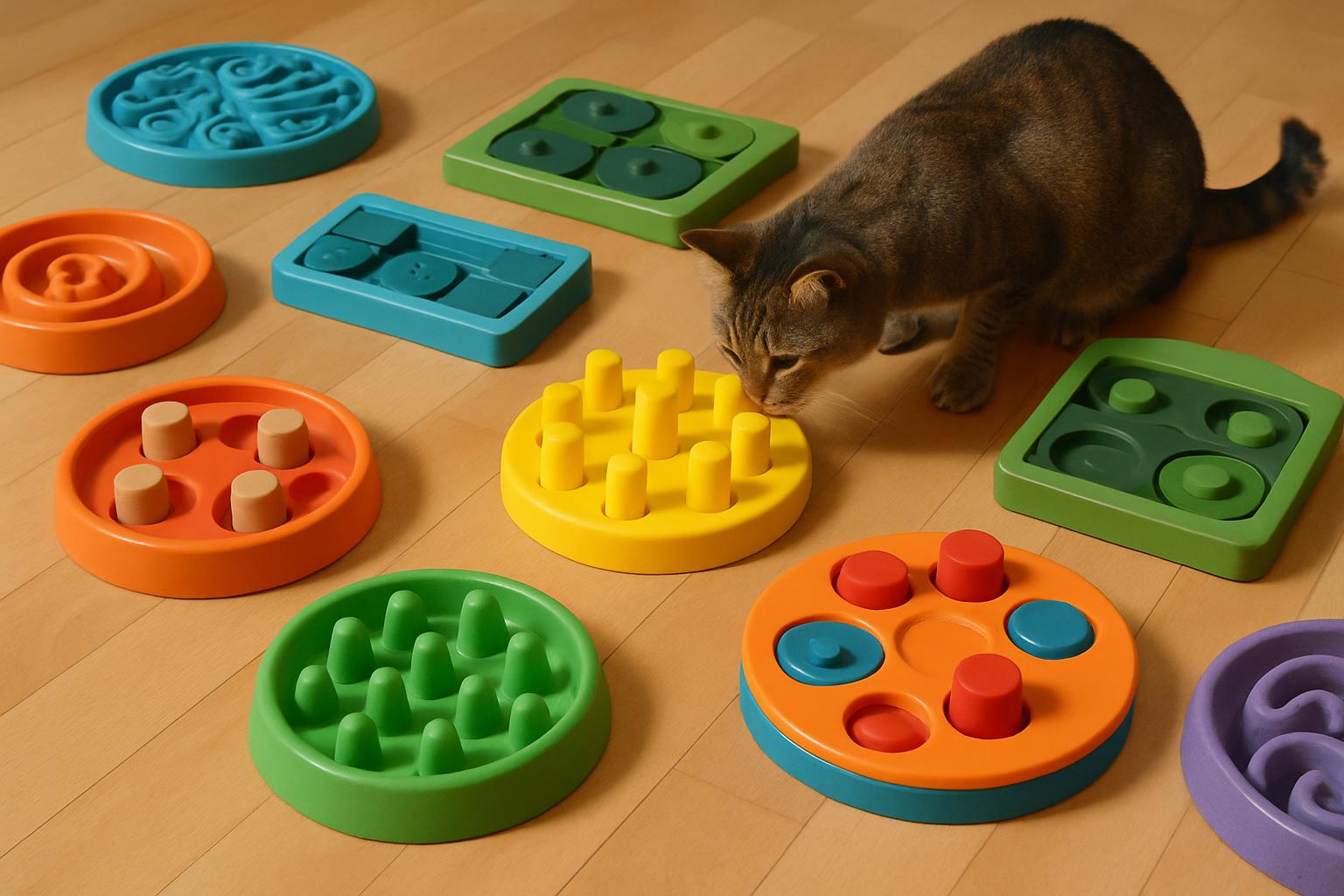
Puzzle feeders solve this by making mealtime a mental challenge. They slow down eating, provide genuine enrichment, and engage the predatory instincts that are built into every cat. If your cat is bored, a puzzle feeder is one of the highest-impact enrichment tools you can add. For more enrichment ideas, see our indoor cat enrichment guide.
Puzzle Feeder Difficulty Levels: Start Easy
One of the most common mistakes is starting with a puzzle that’s too hard. A frustrated cat who can’t figure out the feeder will walk away and never try again. Puzzle feeders generally fall into three tiers:
- Level 1 (Beginner): Simple holes, tubes, or wobble balls. Cats figure these out in minutes but still benefit from the slowed eating and light challenge.
- Level 2 (Intermediate): Multiple steps required — move a piece, then reach in, or navigate a maze. Takes most cats 5–15 minutes per meal.
- Level 3 (Advanced): Complex multi-step challenges, hidden compartments, or pattern-recognition requirements. Best for highly food-motivated, intelligent cats who’ve mastered easier puzzles.
Always start at Level 1 and let your cat succeed before moving up. Success builds engagement; failure builds avoidance.
Best Puzzle Feeders for Indoor Cats
1. Catit Senses 2.0 Food Tree — Best for Beginners
The Catit Senses Food Tree is one of the most popular puzzle feeders on the market, and it earns that status by being genuinely well-designed for cats at any experience level. Kibble or treats are loaded into the top, then drop through a series of levels as the cat paws at openings on each tier. The speed of delivery can be adjusted by changing the peg positions — wider openings for beginners, smaller gaps for experienced puzzlers.
The tower design is physically engaging: cats have to figure out which holes to reach into, then use their paws to maneuver food down through the levels. It’s stimulating without being frustrating, which is exactly the balance you want for a first puzzle feeder.
The Catit Food Tree is made from BPA-free plastic and disassembles completely for cleaning. All pieces are top-rack dishwasher safe, which makes maintenance genuinely easy — a major factor if you plan to use this daily.
Difficulty: Level 1–2 (adjustable)
Pros:
- Adjustable difficulty — works from beginner to intermediate
- BPA-free, dishwasher safe — easy to clean
- Fully disassembles for thorough cleaning
- Large capacity — holds enough for a full meal
- Engaging tower design that cats use their paws to work
Cons:
- Kibble only — not suitable for wet food
- Can be noisy on hard floors when cats bat it around
- Some cats solve the beginner level too quickly
Best for: Cats new to puzzle feeders; households that want easy daily cleaning.
2. Trixie Activity Fun Board — Best Intermediate Multi-Station Puzzle
The Trixie Activity Fun Board takes a different approach: instead of one type of challenge, it offers five different feeding stations in one unit. There’s a cone section, a tunnel row, a peg maze, a flip-lid compartment, and a small bowl section — each requiring a different technique to extract food.
This variety is genuinely enriching. Cats have to engage different cognitive skills and different physical approaches at each station. For cats who’ve mastered simpler puzzles, the multi-station format keeps them engaged longer and provides more complete mental stimulation per meal.
The board is made from food-safe plastic with a non-slip base that keeps it from sliding around on smooth floors. It’s hand-wash only (not dishwasher safe), which is the main maintenance downside. The peg areas require careful cleaning to prevent kibble dust buildup in the grooves.
Difficulty: Level 2 (intermediate)
Pros:
- Five different challenge types in one unit
- Engages multiple cognitive skills per meal
- Non-slip base stays put during use
- Food-safe materials throughout
- Good for cats who’ve outgrown beginner puzzles
Cons:
- Hand wash only — more cleaning effort than dishwasher-safe options
- Small crevices in peg areas accumulate kibble dust
- Not suitable for wet food
- Some cats find certain stations too easy and ignore others
Best for: Intermediate-level cats who need more challenge than a basic wobble feeder.
3. Doc & Phoebe Indoor Hunting Feeder — Best for Natural Feeding Instincts
The Doc & Phoebe Indoor Hunting Feeder takes the most naturalistic approach of any feeder on this list. Instead of a puzzle board or tower, it comes with five small mice-shaped feeders that you fill with kibble and hide around your home. Your cat has to “hunt” — find the mice, then figure out how to extract the food from each one.
This approach is uniquely effective because it mimics actual hunting behavior rather than just puzzle-solving. Cats have to use their nose to locate the feeders, then manipulate them physically to release food. The hide-and-seek element adds an active, room-roaming dimension that static puzzles can’t replicate.
The mice are made from food-safe materials and are top-rack dishwasher safe. The filling process takes about 60 seconds for all five. For cats that wolf down their food in seconds, this system turns a 30-second meal into 20–30 minutes of active engagement.
Difficulty: Level 1–2
Pros:
- Mimics natural hunting — engages instincts static puzzles miss
- Forces cats to move and search rather than just manipulate
- Dishwasher safe — easy to clean
- Excellent for fast eaters who need meals dramatically slowed
- Stimulates nose work (scent tracking) in addition to tactile challenge
Cons:
- Finding all 5 feeders can be challenging for owners too
- Not appropriate for wet food (kibble only)
- Takes more daily effort to hide and set up than static puzzles
- Small pieces — potential concern in households with young children
Best for: Active, high-energy cats; fast eaters; owners who want to provide the most naturalistic mealtime experience.
4. PetSafe SlimCat Interactive Ball — Best Beginner Ball Feeder
The PetSafe SlimCat is the simplest effective puzzle feeder on the list: a hollow ball with adjustable holes that dispenses kibble as the cat bats it around. It sounds basic because it is — and that’s exactly what makes it perfect as a first puzzle feeder or a supplement to more complex puzzles.
The hole size is adjustable in three positions, allowing you to make food release easier or harder. Cats immediately understand the mechanic (bat the ball, get food), which creates instant positive association. The ball encourages physical activity too — cats chase it around the room as they eat, turning mealtime into exercise.
The SlimCat is made from food-safe plastic, disassembles easily for cleaning, and is dishwasher safe. It’s inexpensive enough to buy multiple and rotate them for variety.
Difficulty: Level 1
Pros:
- Extremely easy to introduce — cats figure it out immediately
- Adjustable hole size (3 settings)
- Encourages physical activity alongside mental engagement
- Dishwasher safe — effortless cleaning
- Very affordable — buy multiple for variety
Cons:
- Noisy on hard floors — not ideal for nighttime feeding
- Kibble only
- Too simple for experienced puzzle cats
- Ball can roll under furniture
Best for: First-time puzzle feeder users; supplement to other puzzles; cats who need more exercise.
5. Nina Ottosson Dog Brick (Cat-Compatible) — Best Advanced Puzzle
Nina Ottosson is the gold standard of animal puzzle toy design, and while her products are labeled for dogs, the intermediate and beginner tiers work very well for cats. The Dog Brick (Level 2) features flip-open compartments, removable bone pieces that must be moved to uncover food, and slide-out sections — all on a flat board that cats manipulate with their paws.
For a cat who’s mastered simple feeders and needs genuine cognitive challenge, Nina Ottosson puzzles provide it. The multi-step process — slide this piece, flip that lid, reach into the compartment — takes most cats several minutes per meal and requires genuine problem-solving rather than just persistence.
The materials are food-safe plastic. The board is not dishwasher safe (the moving pieces can warp), so hand washing is required. Cleaning takes about 5 minutes if done promptly after each use.
Difficulty: Level 2–3
Pros:
- Multi-step puzzle requiring genuine problem solving
- Multiple compartment types — keeps advanced cats engaged
- Well-made by a leading puzzle toy designer
- Works with kibble or small treats
- Cats can use both paws in different ways
Cons:
- Hand wash only — takes more effort to clean
- Too difficult for beginners — will cause frustration
- Designed for dogs — some compartments may be sized awkwardly for smaller cats
- Higher price point
Best for: Experienced puzzle cats who need a real challenge; highly food-motivated cats who solve easier puzzles too quickly.
6. Licki Mat Slow Feeder — Best for Wet Food
Most puzzle feeders only work with dry kibble, which leaves wet food cats without good options. The Licki Mat fills this gap with a textured silicone mat that you spread wet food, pate, or soft treats across. The texture creates micro-compartments that slow licking dramatically — turning a 15-second wet food meal into 5–10 minutes of engagement.
The silicone is dishwasher safe and flexible enough to bend around tight spaces for cleaning. It’s also freezer-safe, so you can prep Licki Mats in advance and freeze them for longer-lasting enrichment. Frozen Licki Mats are popular for keeping cats occupied during vet visits, nail trims, or other stressful situations.
Difficulty: Level 1
Pros:
- Works with wet food, pate, and soft treats — fills a gap most feeders miss
- Dishwasher and freezer safe
- Can be prepped and frozen for extended enrichment
- Useful during stressful situations as a distraction tool
- Easy to introduce — cats immediately understand licking
Cons:
- Too simple for experienced puzzle cats
- Limited engagement time compared to complex puzzles
- Some cats learn to fold the mat to access food faster
Best for: Wet food cats; cats new to enrichment feeders; use during stressful grooming or vet situations.
Material Safety: What to Look For
All puzzle feeders that contact food should be made from food-safe materials. For plastic feeders, look for BPA-free labeling. Avoid feeders with paint, dye, or finishes inside food compartments. Silicone feeders (like Licki Mats) should be food-grade silicone — check product listings for this specification.
Inspect puzzle feeders regularly for cracks or chips in plastic, which can harbor bacteria. Replace any feeder that’s cracked, warped, or showing significant wear inside food areas.
Cleaning Guide by Feeder Type
- Dishwasher-safe plastic feeders (Catit Food Tree, SlimCat, Doc & Phoebe mice): Rinse immediately after use, run top-rack in dishwasher. Weekly deep cleaning recommended.
- Hand-wash only feeders (Trixie Fun Board, Nina Ottosson): Wash with warm soapy water immediately after use. Use a small brush for grooves and pegs. Rinse thoroughly and air dry.
- Silicone mats (Licki Mat): Dishwasher safe. For stuck food, soak briefly in warm water first.
Daily cleaning is important for wet food feeders. Dry kibble feeders can go 2–3 days between washes if wiped down between uses, but weekly full cleaning is a minimum for hygiene.
For more on optimizing your cat’s feeding setup, see our guide to building a better feeding station. If your cat eats too fast even with puzzle feeders, our roundup of best automatic feeders for two cats covers timed options that can help manage portions. And if you’re wondering whether your cat actually needs enrichment, check our article on signs your indoor cat is bored.
Frequently Asked Questions
How do I introduce a puzzle feeder to a cat who’s never used one?
Start by making it extremely easy. Use a Level 1 feeder with the holes at maximum size, and place treats inside that your cat is highly motivated to get. Let them watch you put the food in. If they’re hesitant, try scattering a few pieces of food near the feeder so they discover the connection between the object and the reward. Most cats figure out beginner feeders within 10–15 minutes of first exposure — but let it be their discovery, not yours forcing their paws.
Can I use a puzzle feeder for wet food?
Most puzzle feeders are designed for dry kibble only. Wet food gets trapped in small compartments and is much harder to clean thoroughly. The Licki Mat is the best option for wet food — it’s designed for it and is genuinely easy to clean. Some owners use shallow puzzle boards with wet food portions but find cleaning tedious.
How long should mealtime take with a puzzle feeder?
A good goal is 10–20 minutes for a full meal. If your cat is finishing in under 5 minutes, the puzzle is too easy — increase difficulty or add more feeder stations. If they’re still at it after 30 minutes and show frustration, the puzzle may be too hard for their current level.
Are puzzle feeders safe for kittens?
Yes, with appropriate choices. Stick to Level 1 feeders for kittens, avoid small pieces that could be swallowed, and supervise initial use. The SlimCat ball and Catit Food Tree (set to the easiest setting) are good kitten-safe starting points. Wait until kittens are coordinated enough to successfully manipulate the feeder before expecting them to work independently.
Can puzzle feeders help with weight loss in cats?
Indirectly, yes. Puzzle feeders slow eating dramatically, which allows your cat’s satiety signals to catch up with food intake — reducing the urge to demand more food immediately after eating. The physical activity involved in some feeders (like the SlimCat ball) adds a small caloric burn. However, puzzle feeders don’t replace portion control for weight management — they complement it. Work with your vet on the right caloric target first.
My cat ignores the puzzle feeder — what should I do?
First, check the difficulty level. If the puzzle is too hard, cats will give up quickly. Try an easier feeder first. Second, try different treats or food — high-value motivators like freeze-dried chicken can kickstart interest that regular kibble doesn’t. Third, try feeding only from the puzzle feeder at mealtimes (removing the regular bowl) — hunger is a powerful motivator. Most cats come around within 3–7 days of consistent puzzle-only feeding.