
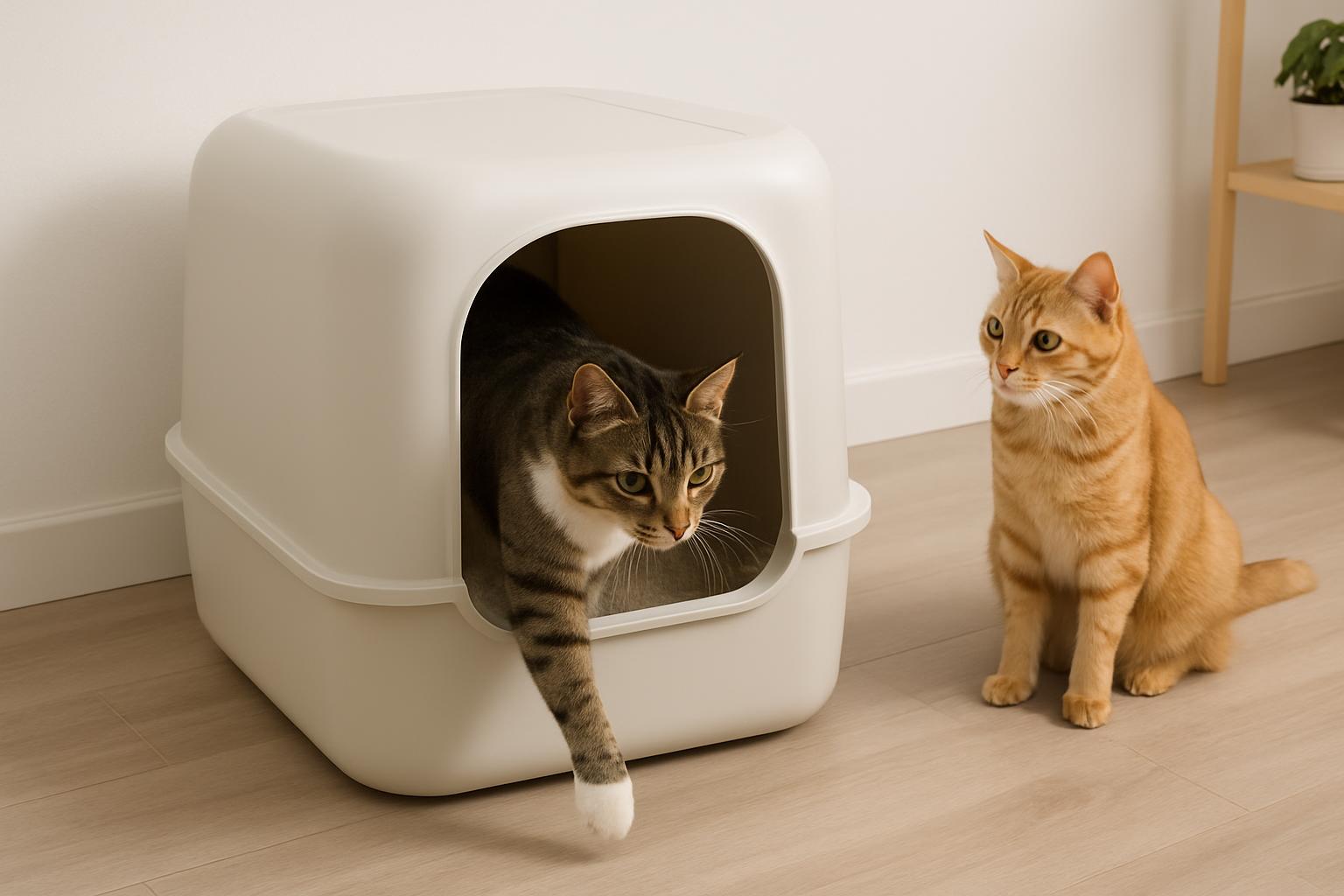
Managing litter for multiple cats is one of the most underestimated challenges in multi-cat households. It’s not just about having enough boxes — it’s about having boxes that are large enough, easy enough to clean frequently, and positioned correctly so every cat feels comfortable using them. The wrong setup leads to litter box avoidance, house soiling, and significant stress for both you and your cats.
This guide covers the best litter boxes for multi-cat households, including automatic options that reduce scooping frequency and large traditional boxes for households that prefer manual cleaning. For litter box fundamentals, start with our litter box setup guide. For managing just two cats, see our guide to litter boxes for 2 cats.
The n+1 Rule: How Many Litter Boxes Do You Actually Need?
The standard recommendation from veterinary behaviorists is one litter box per cat, plus one extra. This is the “n+1 rule.” For two cats, that means three boxes minimum. For three cats, four boxes. Why the extra? It prevents any single cat from monopolizing a box and ensures that if one box is dirty or blocked, another is always available.
In practice, the quality and size of the box matters as much as the count. One large, well-maintained automatic box may serve two cats better than three small boxes that are rarely cleaned. But don’t use automatic box count as an excuse to have fewer boxes than recommended — especially in early multi-cat household setups.
Sizing: Bigger Is Almost Always Better
Most cats prefer a litter box that is at least 1.5x the length of their body. For an average adult cat (18 inches body length), that’s a 27-inch box. Most commercial litter boxes fall short of this — another reason multi-cat households often benefit from large or jumbo options, or even storage totes used as DIY litter boxes.
The 6 Best Litter Boxes for Multiple Cats
1. Litter-Robot 4 — Best Automatic Litter Box for Multiple Cats
The Litter-Robot 4 is the gold standard in automatic litter boxes, and it’s built specifically with multi-cat households in mind. The self-cleaning globe rotates after each use, depositing waste into a sealed drawer below — no scooping required. The OmniSense detection system weighs cats on entry and tracks individual usage patterns via the Whisker app, giving you health data on each cat’s bathroom habits.
The Litter-Robot 4 can handle two cats on its own with proper maintenance, and three cats with twice-weekly drawer emptying. The globe opening is large enough for most breeds, the unit is quiet enough that skittish cats can adjust, and the app alerts you when the drawer is full, when a cat hasn’t used it within a set period, or when usage seems abnormal.
The price is significant — this is a premium investment. But for busy multi-cat households where daily scooping is unrealistic, the ROI in time saved and reduced litter box avoidance issues is real. It requires clumping clay litter and a ~15 amp dedicated outlet for reliable operation.
Pros:
- Fully automatic — no scooping required
- Per-cat usage tracking via app
- Large interior accommodates most cat sizes
- Sealed waste drawer controls odor excellently
- Health monitoring and alerts
Cons:
- Very high upfront cost
- Requires clumping clay litter only
- Large footprint — needs dedicated space
- Some cats need time to accept the rotating mechanism
- Occasional mechanical issues require support
Best for: Two or three cat households where low-maintenance is worth the premium investment.
2. PetSafe ScoopFree Self-Cleaning Litter Box — Best Mid-Range Automatic
The PetSafe ScoopFree offers automatic cleaning at a significantly lower price than the Litter-Robot. It uses disposable crystal litter trays — the rake sweeps waste into a covered compartment automatically after each use, and the crystal litter absorbs and dehydrates urine to reduce odor between tray changes.
For a two-cat household, trays last approximately 2–3 weeks before needing replacement. For three or more cats, expect weekly tray changes, which does add up in ongoing cost. The original ScoopFree model is open-top; the Plus version includes a hood for better odor containment.
The ScoopFree is a good middle-ground option for households that want automatic cleaning without the Litter-Robot’s price tag. It’s less sophisticated in monitoring and detection, but the core function — automatic raking — is reliable. For apartment considerations, see our litter boxes for apartments guide.
Pros:
- Automatic raking reduces scooping frequency significantly
- Crystal litter is very effective at odor control
- Affordable entry price vs. Litter-Robot
- Disposable trays make full cleaning easy
- Hood available for better odor containment
Cons:
- Ongoing disposable tray costs
- No app monitoring or health tracking
- Not all cats accept crystal litter texture
- Tray changes more frequent in multi-cat homes
Best for: Two-cat households wanting automatic convenience without Litter-Robot’s price point.
3. Nature’s Miracle Multi-Cat Self-Cleaning Litter Box — Best for Easy Manual Cleaning
Not everyone wants to commit to an automatic box. The Nature’s Miracle Multi-Cat litter box takes a different approach: it’s a large manual box with antimicrobial plastic and a non-stick coating that makes scooping and cleaning significantly faster than standard plastic boxes.
The non-stick interior means clumps release cleanly without residue sticking to the walls — a genuine time-saver when you’re scooping for multiple cats daily. The antimicrobial plastic reduces bacterial growth and odor between cleanings, and the high-walled design contains spray and scatter effectively.
At roughly 23″ x 18″, it’s large enough for most cats with room to turn comfortably. For multi-cat households that prefer manual boxes with frequent cleaning over automatic systems, this is the most user-friendly option in the traditional category.
Pros:
- Non-stick coating makes scooping and cleaning fast
- Antimicrobial plastic reduces odor between cleanings
- High walls contain spray and scatter
- Large interior — adequate for most cat sizes
- No power or supplies required
Cons:
- Still requires daily scooping in multi-cat homes
- No odor containment between cleanings (open top)
- Non-stick coating degrades over time with harsh cleaners
Best for: Multi-cat households committed to daily scooping who want the cleanest, easiest manual cleaning experience.
4. Petmate Giant Litter Pan — Best Value Large Box
Sometimes the best solution is the simplest: a very large, open-top pan that gives cats maximum space and makes cleaning straightforward. The Petmate Giant is one of the largest traditional litter pans available, with dimensions around 24″ x 17″ and a generous depth that contains scatter.
There’s no mechanism to break, no filter to replace, no app to manage. It’s a large, durable plastic pan with a built-in rim to reduce litter spillage. For multi-cat households on a budget that do daily scooping, one or two Petmate Giants cover the basics reliably and cheaply. The large size means cats never feel cramped, and there’s room for two cats to use simultaneously if needed.
This is also a popular choice as a base box for DIY furniture enclosures, since its standard rectangular dimensions fit well inside modified storage ottomans or custom-built cat furniture. For full multi-cat home planning, see our multi-cat home setup guide.
Pros:
- Very large interior — maximum cat comfort
- Simple, no-mechanism design — nothing to break
- Extremely affordable
- Built-in rim reduces scatter
- Easy to find and replace
Cons:
- Open top — no odor containment
- No special features or enhancements
- Large footprint requires dedicated space
- Basic plastic can absorb odors over time
Best for: Budget-conscious multi-cat households committed to regular maintenance who want maximum space per dollar.
5. Van Ness Large High Sides Enclosed Cat Pan — Best Hooded for Multiple Cats
The Van Ness Large Enclosed Cat Pan brings together a traditional hooded design with a genuinely large interior — making it one of the better hooded options for multi-cat households that want odor containment without going automatic. The full hood with door flap traps odors between scoopings and gives cats privacy and security.
The built-in odor door has a replaceable carbon filter, and the full-height hood is tall enough for larger cats to stand and turn comfortably. Cleaning requires removing the hood, which lifts off entirely, giving full access to the base pan. The door flap can be removed for cats that prefer an open entrance.
For households where the litter box is in a visible area and odor containment is critical, the Van Ness provides a balance of size, containment, and affordability that premium brands struggle to match at this price point.
Pros:
- Full hood provides strong odor containment
- Large interior adequate for most cat sizes
- Replaceable carbon filter
- Hood lifts off fully for easy cleaning
- Door flap removable for cat preference
Cons:
- Some cats dislike enclosed spaces
- Hood can make scooping slightly less convenient
- Filter needs periodic replacement
- Not as large as open-pan options
Best for: Multi-cat households where odor containment is important and a hooded design is preferred over open or top-entry.
6. Jumbo Storage Tote DIY Litter Box — Underrated Best Value
This isn’t a commercial product — it’s a 66-quart Sterilite or Rubbermaid storage tote with a hole cut in the lid or side. DIY litter box enthusiasts swear by these, and the reasons are compelling: they’re larger than almost any commercial litter box, they’re cheap (under $15), the high walls completely contain spray and scatter, and the solid construction lasts for years.
Cutting the entry hole takes ten minutes with a utility knife. Position the hole on the short end or top depending on your cats’ preference. The tall walls (typically 16–18″) mean even high-spraying male cats won’t mark outside the box. For multi-cat households needing large-capacity boxes on a budget, three of these spread around the home costs less than one mid-tier commercial box.
The downside is aesthetics — they look like storage totes, because they are. For visible areas, use a furniture enclosure. For bathrooms, closets, or utility areas, the DIY tote is arguably the smartest choice for multi-cat households.
Pros:
- Largest interior available at any price
- Extremely affordable
- Very high walls eliminate spray and scatter
- Durable — lasts for years
- Multiple size options available
Cons:
- Requires DIY cutting (10–15 min setup)
- Looks like a storage tote, not a cat product
- No features, filters, or conveniences
Best for: Budget-conscious multi-cat households that prioritize size and practicality over aesthetics.
Multi-Cat Litter Box Setup: What Actually Works
Follow the n+1 Rule Without Exception
Do not try to get by with fewer boxes than cats +1. Litter box competition is one of the most common causes of house soiling and inter-cat aggression in multi-cat homes. This is not optional.
Spread Boxes Across the Home
Never put all litter boxes in one location. A dominant cat can guard a single bathroom and prevent other cats from accessing any box. Distribute boxes across different rooms or floors.
Scoop More Frequently Than You Think You Need To
Cats dislike dirty boxes. With multiple cats, a box that would be fine for 24 hours with one cat may need scooping after 8–12 hours with two or three cats. If cats start eliminating outside the box, soiling frequency is often the first thing to check.
Monitor Box Usage Patterns
If you have an automatic box like the Litter-Robot with per-cat tracking, unusual usage drops can indicate health issues. Even with manual boxes, noting which box is used most frequently and which cat uses which box helps you spot problems early.
Frequently Asked Questions
How many litter boxes do I need for 3 cats?
Four boxes minimum, following the n+1 rule. Position them in at least two different locations in the home so no single cat can control access.
Can the Litter-Robot handle 3 cats?
Yes, but you’ll empty the waste drawer more frequently — approximately every 5–7 days for three cats. Litter-Robot recommends their unit for up to 3–4 cats depending on size.
What litter type works best in multi-cat households?
Premium clumping clay litter forms tight clumps that remove completely, minimizing odor and residue. World’s Best Cat Litter (corn-based) and Dr. Elsey’s Ultra are popular choices for multi-cat homes.
Why is my cat not using the litter box?
Common causes in multi-cat homes: dirty box, competition with another cat, box location (near food, traffic, appliances), box type (some cats dislike hoods), or medical issues. Start with cleanliness and location before assuming behavioral problems.
Do I need one automatic box per cat or can they share?
The Litter-Robot can be shared by 2–3 cats. Most other automatic boxes work best with one per cat in multi-cat households. For two cats, one Litter-Robot 4 plus one manual backup box is a common setup.
Our Recommendation by Household Type
- 2 cats, want automatic: Litter-Robot 4 + one manual backup
- 2 cats, manual preference: Two Nature’s Miracle Multi-Cat boxes, positioned separately
- 3+ cats, budget: Three or four jumbo storage tote DIY boxes spread across the home
- 3+ cats, premium: One Litter-Robot 4 + two large manual boxes
- Apartment with 2 cats: See our litter boxes for apartments guide for space-saving setups
The best multi-cat litter box setup is one that’s large enough, cleaned frequently enough, and distributed well enough that every cat always has a clean, accessible box. The specific product matters less than the habits and placement around it.